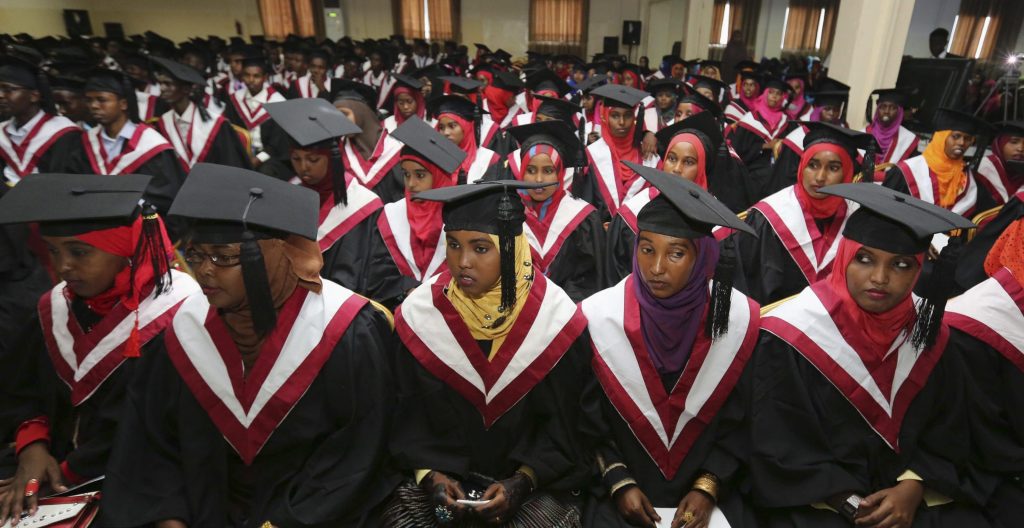
Transformation for Excellence

Transit College educates talented students in
technical skills, engineering, science & technology, management, education, theology and humanities in preparation for careers of professional practice, civic impact, and leadership; anchored by fairness, merit and a commitment to active lifelong learning.
Programs

The mandate of the School is to advance knowledge generation for sustainable agricultural development and natural resource management.  The School is administratively managed under seven departments.

  1. Department of Crop Science
  2. Department of Soil Science
  3. Department of Animal Sciences
  4. Department of Environmental Sciences
  5. Department of Agricultural Engineering
  6. Department of Forestry
  7. Department of Food Science and Technology

The School of Business and Management is mandated to train graduates in business management and innovative entrepreneurial skills.  The School is managed under five departments.

  1. Department of Business Administration
  2. Department of Entrepreneurship
  3. Department of Commerce
  4. Department of Economics and Statistics
  5. Department of Computing and Information Technology

The mandate of the School of Education is to train teachers, well-grounded in their respective disciplines in arts or sciences, ready to match the rapidly changing global patterns and trends of affairs.  The School is managed under four departments.


  1. Department of Primary Education
  2. Department of Secondary – Science Education
  3. Department of Secondary – Arts Education
  4. Department of Adult and Continuing Education

The mandate of the School of Engineering is to train engineers well-grounded in engineering fundamentals while exhibiting high standards of professional and ethical codes of conduct.  The School of Engineering has seven departments.

  1. Department of Mechanical Engineering
  2. Department of Civil Engineering
  3. Department of Electrical Engineering
  4. Department of Architecture and Planning
  5. Department of Mineral and Petroleum Engineering
  6. Department of Fine Art and Design
  7. Department of Water Engineering

The mandate of the School of Humanities and Social Sciences is to lead in training of Arts and Humanities graduates ready to meet the rapidly changing global trends.  It has three departments.


  1. Department of Humanities
  2. Department of Social Sciences
  3. Department of Performing Arts

The mandate of the School of Medicine and Allied Sciences is to train personnel focusing on developing necessary key competences in medicine to meet the health care needs of the global population.  The School has four departments.

  1. Department of Nursing and Midwifery
  2. Department of Medicine
  3. Department of Pharmacology
  4. Department of Public Health

The mandate of the School of Science and Technology is to train scientists that are well-grounded in scientific principles and highly motivated to advance technological innovations.  Currently, the School has seven departments.


  1. Department of Chemistry
  2. Department of Physics
  3. Department of Mathematics
  4. Department of Biological Sciences
  5. Department of Sports Sciences
  6. Department of Geological Sciences
  7. Department of Information, Communication Technology

The mandate of the School is to train pastors for pastoral and academic ministries in the communities.  The School has two departments.


  1. Department of Theology
  2. Department of Missions

The mandate of the office is to organize short and medium term courses to improve the knowledge base and skills of students in their field of specialization.  Some of the courses are:


  1. Short Course in Microsoft Office Suite
  2. Short Course in Mining Safety
  3. Short Course in Petroleum Safety
  4. There are a number of short Safety Courses ranging from 8 hours to 30 hours.
Transit A Plus

Transit A Plus is an accelerated program, established by Transit Mission, for people who have unsuccessfully attempted WAEC examinations leading to WASSCE award but still have ambitions to undertake college education.  It is a second-to-none program in improving the educational status of the population being a two-pronged strategy.  This is the first phase of Transit A Plus implementation.   Transit Mission offers such persons a place in Transit College in their programme of interest as well as a chance to re-sit WAEC examinations to improve their credits to be able to enter universities directly.  Such students can register for up to five (5) subject including English and Mathematics.  Transit College management will advise the students on the combination of subjects to register for considering their professional ambitions.

The Senior Secondary Certificate Examination Subjects

SCIENCEBUSINESSARTS
Mathematics
English Language
BiologyHome ManagementGeography
ChemistryCost AccountingHistory
Further MathematicsBusiness ManagementGovernment
Health ScienceFinancial AccountingLiterature in English
Agricultural ScienceCommerceFrench
PhysicsEconomicsChristian Religious Education

The student would concurrently pursue a diploma in his/her field of interest and prepares to re-sit WASSCE examinations.  Students are given provisional registration for the programme of their interest but enjoys full privileges of the students of Transit College.  Transit College arranges classes in those subjects the students have registered for in the WAEC examinations and prepares the students for the examinations.

The secondary school program is arranged in modules such that the students would cover the syllabus and sit for examinations within the two years he/she is still at Transit College.    There are in all twenty one (21) modules equally distributed across the three years, seven (7) modules for each year referred to as levels.  At each level, a student registers for the seven modules and at the end sits a comprehensive examinations.  The student then registers for the next seven modules.  When the student completes the 21 modules, the students then does a holistic revision in preparation for WASSCE examinations.

Programs on Offer

Transit College is currently running ten Diploma programmes and a number of short courses for professional skills development. 

Agriculture and food processing industry is very important in African economy as it employs the majority of the population in all the sub-Saharan African countries.  This course focusses on the administration and management of agriculture.  The course covers the planning and monitoring of livestock and crop production services, marketing the products and services.  Students will learn how to develop farm and business plans, climate risk management strategies and sustainable land strategies.

Construction can be very wasteful and costly if not properly managed.  Diploma in Construction Management produces highly skilled project management professionals in the construction industry with adequate knowledge to respond to the demand of the practical world.

In this world of ever changing design taste, Diploma in Architecture, Design and Planning enables combining creativity with technical skills to shape the spaces, services and experiences-both physical and digital-in which we live, work or play.

Diploma in Mining Engineering prepares students for productive, life-long careers in mining and related industries or disciplines. It will provide knowledge useful for producing the region’s mineral resources, educate graduates to work in any area of the mining industry, disseminate newly acquired knowledge via publication of original research, provide professional service to the mining industry and public to assist in the environmentally responsible and safe extraction of mineral resources, and inform the public at large about the importance of mining to society.

Petroleum Engineering is concerned with the exploration for and extraction of hydrocarbons; crude oil and natural gas. This demands use of creative and imaginative knowledge of petroleum geology, reservoir behaviour as well as fundamental engineering principles to develop effective and safe solutions for the exploration, recovery and transportation of hydrocarbon products trapped underground, onshore or offshore, and usually in very challenging environments. With continued worldwide demand for energy, there is no better time to be a Petroleum Engineer.  Petroleum Engineers are at the forefront of ensuring that we have an abundant supply of oil and gas, in a safe and environmentally sustainable manner.  While we have abundant mineral resources in Africa, we usually do not have qualified local people to be recruited in the industry.  There is, therefore, great need to train people who can take up this challenge. 

Management science in the public health arena includes the administrative and managerial approach.  Only an effective and efficient management practice can translate theory, research and scientific innovation into practical solutions for health care.  The course is beneficial to acquire theoretical knowledge and develop practical skills to apply a scientific approach to the management of health services.

Computing and communications technologies lie at the heart of every organization. The delivery of information services includes a technological framework of hardware, software, networks, tools, internet applications and telecommunications equipment as well as the ethical, professional and legal issues which increasingly play a part in the industry. Diploma in Computer Science prepares students to design applications that can securely deliver data and information.

Methods of transmission of data and information is changing at a very fast speed. And the computing and communications technologies lie at the heart of every organization. The transmission of data and information demands exhaustive knowledge of the techniques used.  Diploma in Information System and Technology prepares students to develop a communication system that can securely transmit data and information.

A country without skilled workforce cannot effectively compete in the economic development arena.  The preparation of a strong workforce starts from training teachers in imparting knowledge to the young ones who will in turn train others or join other productive workforce.

Transit College

Transit College educates talented students in technical skills, engineering, science & technology, management, education, theology and humanities in preparation for careers of professional practice, civic impact, and leadership; anchored by fairness, merit and a commitment to active lifelong learning.